
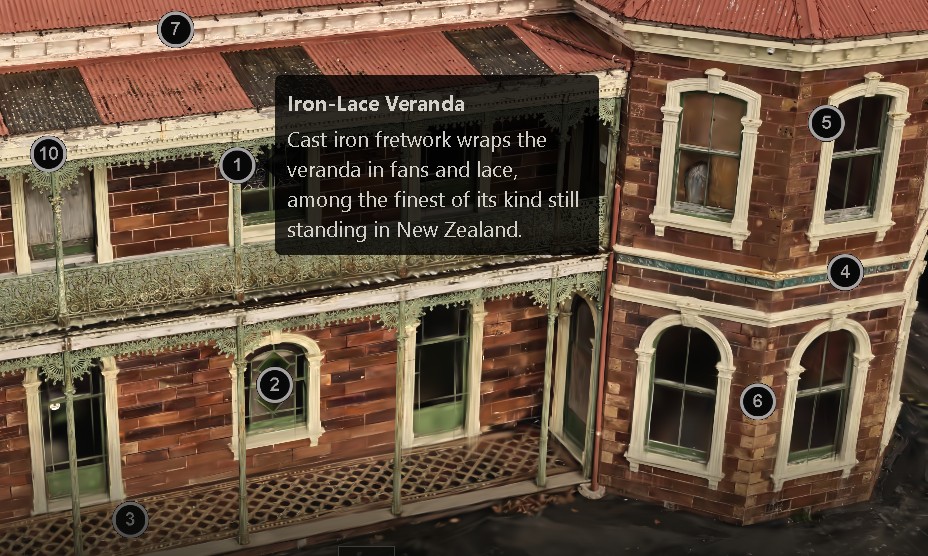
Clark House, known originally as Ngaroma, has been part of Tohu Heritage's photorealistic 3D collection since its capture in Hobsonville earlier this year. Today we're adding the piece that makes it worth returning to: guided, interactive annotations built directly into the model.
Anyone exploring the house online can now click through a series of numbered points placed across the model, each one opening a short note about what they're looking at, whether it's the experimental hollow ceramic blocks Rice Owen Clark II manufactured himself, the ornate iron-lace verandas regarded as among the finest examples of their kind in New Zealand, or the curved staircase that rises through the heart of the house.
A house built from its maker's imagination
Rice Owen Clark II had grown his family's pottery works into one of the most significant ceramic enterprises in the country by the time he built Ngaroma around 1902. The house was both a family home and a bold experiment: he believed hollow ceramic blocks, lighter than brick and naturally insulating, could change how buildings were made across Aotearoa. Clark House was his proof of concept, and it still stands today as a New Zealand Category 1 Historic Place.
Why this matters for how heritage gets shared
A photograph of a curved staircase or an iron-lace veranda tells you it exists. An interactive model lets you actually walk toward it, understand where it sits in the house, and read what makes it significant, all without needing to stand in Hobsonville. That's the gap this update closes for Clark House, and it's the direction every future capture on the site will follow from here.
You can explore Clark House now. Click Explore on the model, then look for the numbered markers.