
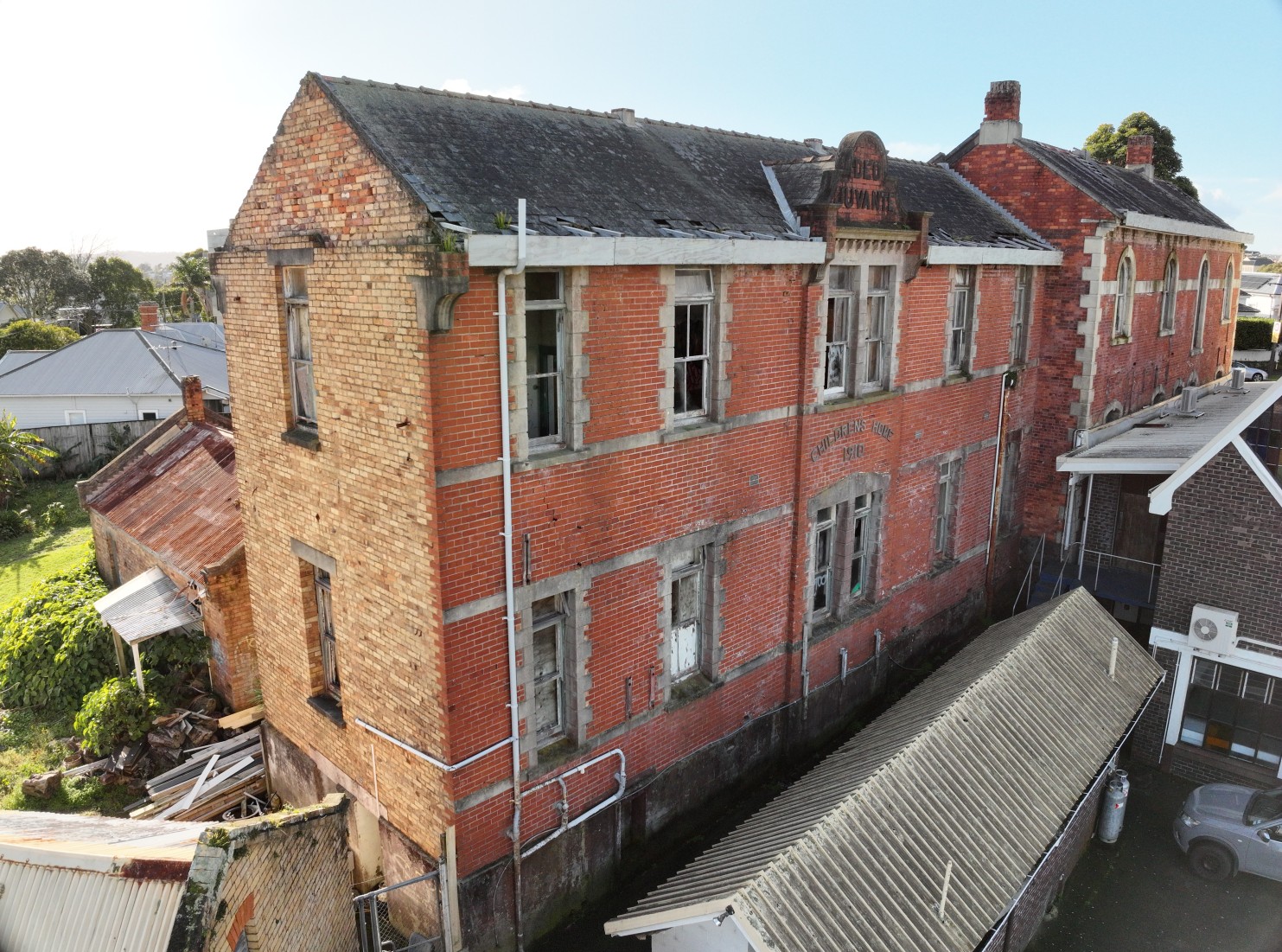
Carlile House / Costley Training Institute (Former). Aerial photo by Thiago Amaral.
New Zealand's infrastructure sector has a well-documented problem: nobody can agree on what condition its assets are actually in. The Office of the Auditor-General has flagged it. Infrastructure New Zealand's own 2026 asset management report flags it too. The core finding, repeated across nearly every report on the subject, is the same: asset condition data is fragmented, isolated within departments, often manually updated, and rarely integrated with the systems that actually make investment decisions.
Local councils run dozens of separate Asset Management Information Systems that were never built to talk to each other. Staff describe doing manual workarounds just to move data between them, extracting information from one system and re-entering it into another, with all the transcription errors that implies. The industry's own name for what's missing is blunt: a single source of truth. One place where the real, current condition of an asset lives, instead of five partial, ageing versions scattered across departments.
Heritage buildings are infrastructure too. Culturally load-bearing infrastructure, in most communities' case, but infrastructure nonetheless: physical assets with a condition, a lifespan, and a cost of doing nothing. And they have exactly the same fragmentation problem, just with almost none of the attention.
What is a single source of truth for a heritage building?
A single source of truth is one authoritative, maintained record holding everything known about a building: its condition, its materials, its alterations, and the evidence behind each of them. New Zealand's infrastructure sector has spent years documenting the cost of not having this. Both the Office of the Auditor-General and Infrastructure New Zealand have reported that asset owners often cannot say reliably what condition their assets are in, because the information sits scattered across disconnected systems, spreadsheets and consultants' reports. Heritage buildings have the identical problem and are rarely treated as part of that conversation. Without one source of truth, every survey, restoration and insurance claim begins by rediscovering what somebody already knew, and the building's accumulated record fragments a little further each time.
The same gap, a different asset class
A 2024 study out of Unitec's Digital Heritage Research Centre surveyed 156 New Zealand heritage professionals, architects, engineers, council staff, and researchers, about digital documentation. The pattern it found will sound familiar to anyone who has read an infrastructure asset management report: where digital records of heritage buildings exist at all, they typically sit on one company's hard drive or one council's server, disconnected from every other record in the country. Every individual laser scan or photographic survey becomes, in the researchers' words, an orphaned record.
There is no national register for heritage digital documentation itself, as distinct from the New Zealand Heritage List, which records legal status and historical significance, not the existence or condition of any digital record. If a building has been scanned, surveyed, or documented in 3D, there is no shared place that says so. Two organisations could digitise the same building without either knowing the other had already done it.
Why this matters more than it sounds like it should
Roads and pipes can be replaced. A demolished or storm-damaged heritage building cannot. When the physical asset is genuinely irreplaceable, the case for a durable, findable digital record is stronger than it is for almost any other asset class, not weaker. Yet heritage documentation gets a fraction of the standardisation, coordination, and data infrastructure that a stormwater network takes for granted.
The infrastructure sector's response to its own fragmentation problem has been slow but real: shared frameworks like the IIMM, moves toward system integration, government reporting that keeps the pressure on. Heritage digitisation hasn't had its equivalent moment yet. There is no widely adopted standard for what a heritage digital record should contain, and no shared home for it once it exists.
What this means going forward
None of this is a criticism of the people doing the work. Councils, heritage consultants, and researchers are digitising buildings under real constraints, with no shared infrastructure to plug into even when they want one. The gap is structural, not a failure of effort.
It does mean that every heritage building documented today, in a format that will still be readable in twenty years, sitting somewhere it can actually be found, is doing double duty: it's a historical record, and it's a small, practical answer to a data problem the rest of the infrastructure sector is still trying to solve at scale. We think that's worth treating as seriously as any other asset register.
You can read more about the research behind this in our earlier piece on digital preservation and New Zealand's heritage buildings.