
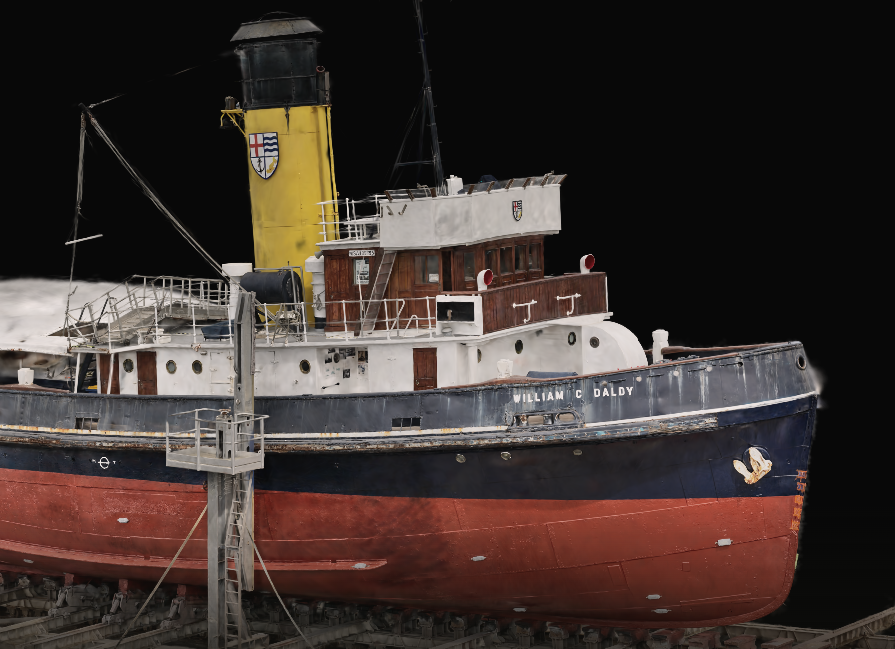
William C. Daldy is the tenth heritage site published on Tohu Heritage, and the second in the Transport category. She is a twin screw, coal fired steam tug, built at Renfrew on the Clyde in Scotland for the Auckland Harbour Board in 1935. After an 82 day delivery voyage she entered service in February 1936, and today she is the only working steam tug left in the Southern Hemisphere.
She runs 126 feet long by 32 feet in the beam and displaces 750 tonnes, driven by two 950 nominal horsepower triple expansion steam engines. She carries the name of Captain William Crush Daldy, a seafarer and merchant who brought his own schooner into Auckland on the day the port's first Customs House opened, in July 1841.
In December 1958, during construction of the Auckland Harbour Bridge, the 1200 ton centre span was being floated into place when a gale force front moved in and the section began drifting up the harbour out of control. With the other tugs on the job unable to hold it, Daldy worked steadily for more than 36 hours and burned around 40 tonnes of South Island coal keeping the span in place until it could be secured. You can explore William C. Daldy now.
Unlike Toroa, Daldy carries real heritage protection: she is listed with Heritage New Zealand Pouhere Taonga as a protected object. That listing does not make the work of keeping her afloat any lighter. Every two years she goes to survey, dry docked or slipped for hull cleaning, hull plate testing, propeller shaft and seal testing and sea valve checks, and her Devonport berth wears at the hull with every tidal rip and ferry wash. That round has just closed: repairs finished at Heron Ship Repair in Whangārei on 11 September 2026, and she went back into the water at first light the same morning.
The Preservation Society is now converting her from coal to wood based fuel, working with MOTAT and the Auckland Steam Engine Society and funded by the Freemasons Foundation, a change that keeps her in survey and doubles as a prototype for other coal burning machinery. Documenting her in photorealistic 3D records the hull and machinery as they stand today, so her condition can be compared across surveys long after this one.