
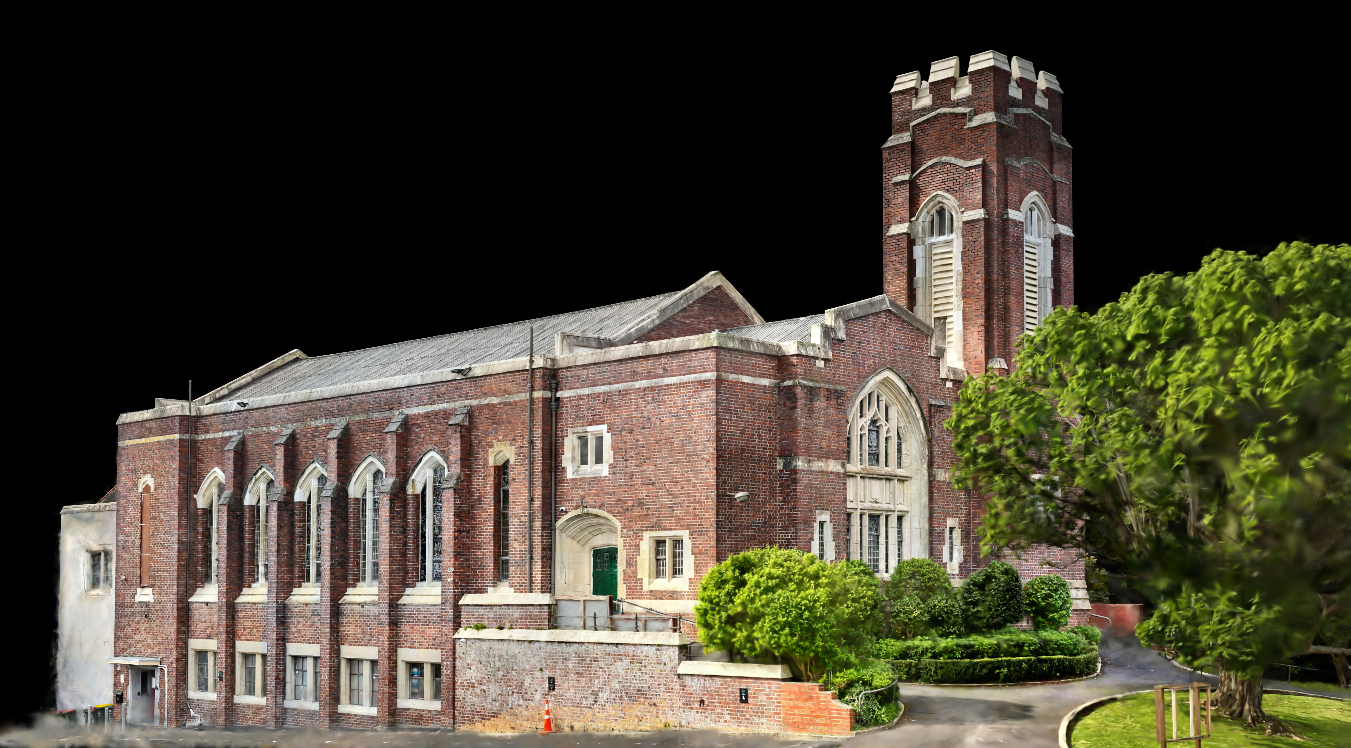
Paul Baragwanath was baptised at St David’s Memorial Church in 1977. Decades later, he’d heard that things were changing at St David’s, so on 26 June 2014, he popped into the building to propose the idea of documenting it photographically before it was upgraded. It was then that he met the church’s minister, who told him the building was not going to be upgraded. It was to be demolished by Christmas.
In the following weeks, Paul assembled a group, the Friends of St David’s, a small group of fifteen to twenty people. But after some months of fundraising, there was still only a few hundred dollars in the bank account. With no money, the group had no hope of changing the fortunes of St David’s. Knowing that time was running out, Paul realised the importance of capturing the interior of the building, as they would soon be locked out. A drone was used to record the church inside and out, capturing the architectural detailing and the beauty of the building.
Slowly, the group built support. They gathered evidence that the building was in fact structurally sound enough to be saved and repurposed, and made the argument that St David’s was not just a church but a living memorial, built after the First World War. Yet this heritage had been forgotten. Demolition was imminent, and a big plan was needed to stop it.
Artist Max Gimblett, who attended St David’s in his childhood, offered Paul his help: “If there’s anything I can do to support the saving of St David’s, let me know.” Max wanted to honour his childhood minister, who had meant so much to him. Paul conceived of a project that would see Max’s artworks become a protective, shimmering cloak of gold across the walls of St David’s. Each quatrefoil would represent a soldier’s hand outstretched. The Art of Remembrance: seven thousand brass quatrefoils hung across the church’s exterior, each one a memorial, and each one for sale. The installation opened on Anzac Eve 2015 and stayed on the walls for three months into winter. What started as a local story spread further. The project was writing St David’s back into history. By July 2015, the campaign had raised one million dollars, the largest sum ever raised through art in New Zealand, a massive feat of grassroots volunteerism, and the gifts of Max Gimblett, his Auckland gallery Gow Langsford, businesses, donations and volunteers.
Some of the quatrefoils went on to be displayed outside the Auckland War Memorial Museum, and at Te Papa in Wellington. Later, in 2018, the Trust fought another battle to see the building gain Category A Historic Heritage status, which meant protection from demolition. Light projections were used to bring the building to life for the local community, and Warwick Freeman’s art jewellery piece Te Tonga Whetu o Te Rangi, the Star of the Southern Sky, re-awakened public interest. St David’s had become known as the building the city did not want to lose.
In 2022, the Friends of St David’s Trust, supported by individuals, trusts and a Give-a-Little campaign, purchased the building and land, and a multi-year, incremental restoration project progressively re-opened the building as Kāhui St David’s, now a centre for music serving the community. None of it happened by accident. It happened because Paul, and the volunteers around him, refused to let the building go. You can explore Kāhui St David’s now.
A note from the founder
It was incredible to hear the story behind this building, straight from Paul. He set out on a remarkable journey and saw it through, refusing to let the building simply be demolished. What he and the community around him achieved, with volunteers, sponsors and funding all pulling in the same direction, is one of the most remarkable heritage stories I’ve ever come across. It’s proof that when we stick together, there’s really nothing we can’t do.