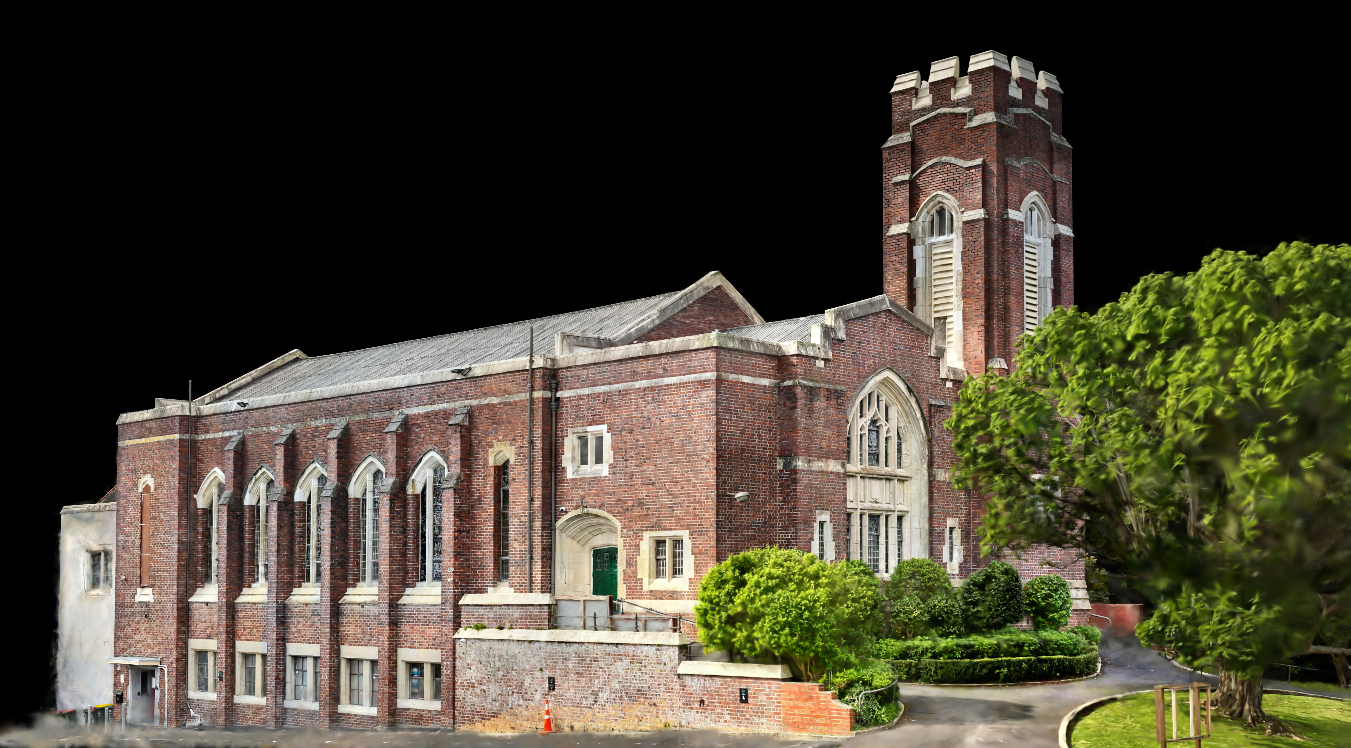
Paul Baragwanath was baptised at St David’s Memorial Church in 1977. Decades later, he still remembers the disappointment of watching the congregation leave the building behind.
On 26 June 2014, he ran into the church’s minister, who told him the building would likely be demolished. Paul was asked to document the place photographically before that happened. Standing there listening, he was overcome. The minister’s words stayed with him.
What followed was months of work by a small group, around twenty people, with almost no funding behind them. At one point the minister stood in front of them and said plainly that the building would come down, and the site would become a carpark. That same year, a drone was used to record the church inside and out, capturing the facade and surroundings before anything could be lost.
Slowly, the group built a case. They gathered evidence that the building was structurally sound enough to be saved and repurposed, and made the argument that St David’s was not just a church but a living memorial, built after the First World War to honour the dead. At one stage, Paul had two weeks to raise $150,000 or the demolition would go ahead. It was as close as that.
Then, unexpectedly, momentum shifted. In 2015, artist Max Gimblett created the Art of Remembrance: seven thousand brass quatrefoils hung across the church’s exterior, each one a memorial and each one for sale. The installation opened on Anzac Day and closed about three months later. What started as a local story spread further, helped by social media attention that no one had counted on. By July 2015, the campaign had raised one million dollars, the largest sum ever raised through art in New Zealand.
Some of the quatrefoils went on to be displayed outside the Auckland War Memorial Museum and at Te Papa in Wellington. Light projections were used to bring the building to life for the local community, and what had once been a building nobody could afford to save became one the city did not want to lose.
The church was granted Auckland Council Category A heritage status in 2019. In 2022, the Friends of St David’s Trust purchased the building outright, and it reopened progressively as Kāhui St David’s, now a centre for music and community life. None of it happened by accident. It happened because Paul, and the volunteers around him, refused to let the building go. You can explore Kāhui St David’s now.
A note from the founder
It was incredible to hear the story behind this building, straight from Paul. He set out on a remarkable journey and saw it through, refusing to let the building simply be demolished. What he and the community around him achieved, with volunteers, sponsors and funding all pulling in the same direction, is one of the most remarkable heritage stories I’ve ever come across. It’s proof that when we stick together, there’s really nothing we can’t do.